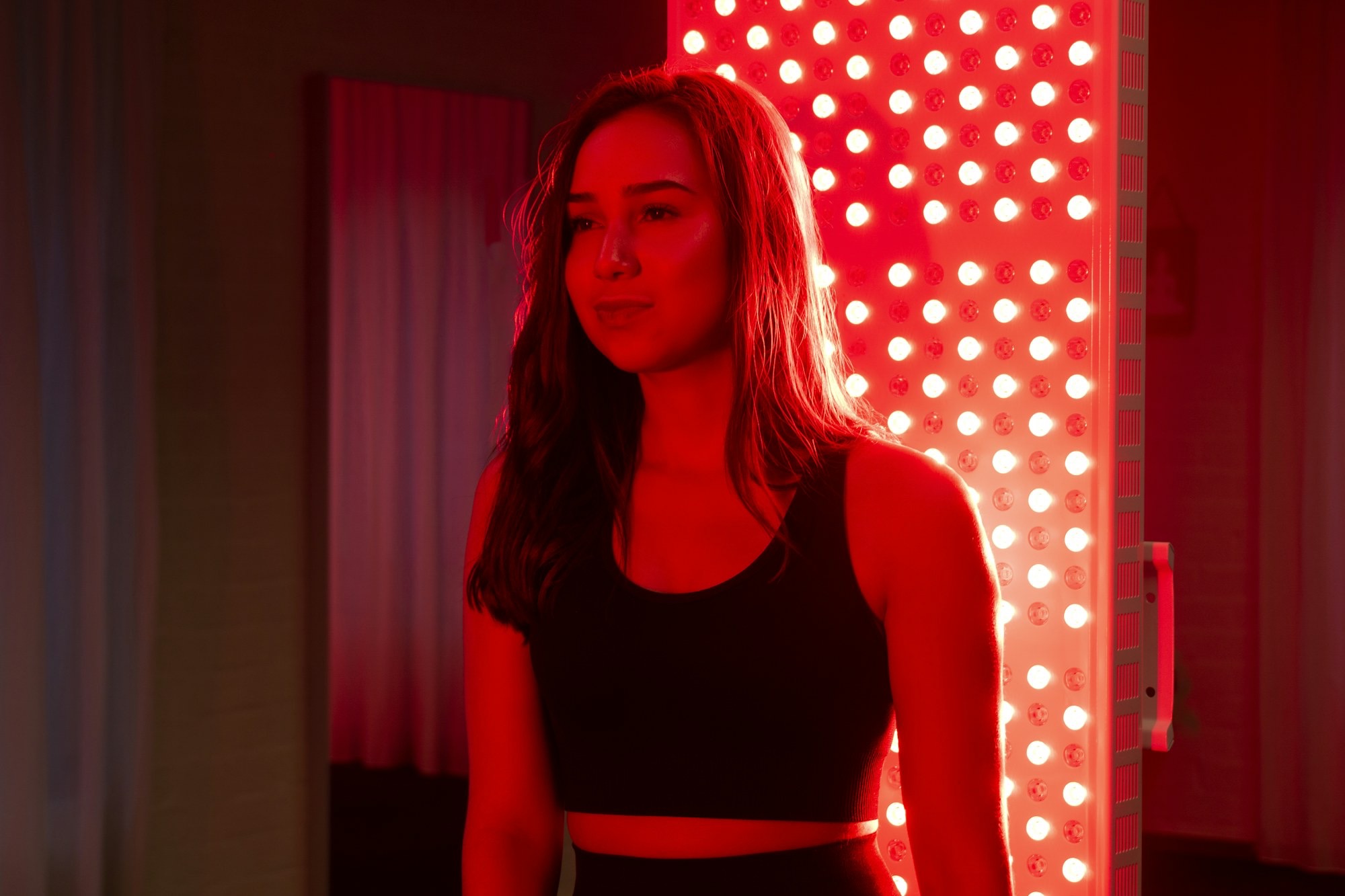
Which red light muscle recovery claims hold up, which wavelengths studies used, how session length is worked out, and where the evidence runs out
Evidence review · Updated · Written by [Author name] · Reviewed by [Reviewer name, credentials]
Quick answer
Red light therapy, also called photobiomodulation, is thought to work through cytochrome c oxidase in the mitochondria, raising cell energy (ATP) production. The table grades each claim by the evidence behind it.
Light before exercise: performance and muscle damage markers (CK, lactate)
ModerateSeveral randomized trials and a 2015 meta-analysis [1]; 830 nm before biceps exercise [5]
Light after exercise: delayed-onset muscle soreness
Mixed630 nm after exercise reduced soreness in one trial [4]; a 2016 meta-analysis found little effect on perceived soreness [3]
Red vs near-infrared
UnclearHead-to-head differences were often not significant [2]
Multi-LED arrays vs single-point probes
LimitedA 69-LED cluster lowered CK; a single 810 nm diode did not [6]
Whole-body exposure for performance or sleep
InsufficientStanford experts describe the data as lacking [7]
Most trials applied light shortly before exercise, from a few minutes to about an hour beforehand. This timing has the strongest evidence for performance and muscle damage markers [1][5].
One trial that applied light in the rest intervals between repeated sprint tests found no clear benefit over placebo [8].
One trial found less soreness and better range of motion after 630 nm light [4]; a meta-analysis found little effect on perceived soreness [3].
Wavelengths used in recovery studies
Fig. 1 — Wavelength (nm). Some studies also used 830, 880 or 950 nm.
Trials used red light around 630–660 nm and near-infrared light around 810–880 nm, sometimes up to 950 nm. Near-infrared light is invisible and is often described as reaching deeper tissue. In head-to-head comparisons, differences between bands were often not significant [2], which is why many devices combine both.
Session time is not a fixed number. It depends on how much light reaches the skin (irradiance) and the dose you aim for (fluence):
Session time
Time (s) = Dose (J/cm²) × 1000 ÷ Irradiance (mW/cm²)
Example: at 50 mW/cm², reaching 10 J/cm² takes 200 s (3 min 20 s). This is arithmetic, not a recommended dose. Irradiance falls as distance grows, so the same device needs longer at 30 cm than at 15 cm.
Most trials tested one session around a single bout of exercise. Evidence on weekly frequency during ongoing training is limited.
Some devices pulse their LEDs at a set frequency in hertz. There is little evidence that pulsing improves muscle recovery over continuous output.
The best red light therapy device for muscles is the one that covers the muscles you train and reaches your target dose in a practical session time. Compare devices on measured irradiance at a stated distance and on treatment area, not on LED count or wattage.
Red light panel
CoverageOne region per position, e.g. both legs
Suited toStudios, clinics, home gyms
Full-body system
CoverageWhole body at once
Suited toHigh-volume recovery studios
Wrap
CoverageOne joint or muscle group
Suited toClinics, teams, travel
Mat
CoverageBack and legs, lying down
Suited toStudios, athlete recovery products
It depends on the device's irradiance and the dose you aim for. Time in seconds equals the dose in J/cm² × 1000 ÷ irradiance in mW/cm². A device delivering 50 mW/cm² needs 200 seconds to reach 10 J/cm². This is an arithmetic example, not a recommended dose.
Most trials tested one session around a single bout of exercise. Evidence on weekly frequency during ongoing training is limited, so follow the device maker's guidance.
One trial that applied light in the rest intervals between repeated sprint tests found no clear benefit over placebo [8]. Most trials applied light shortly before exercise instead.
Trials used red light around 630–660 nm and near-infrared light around 810–880 nm. Head-to-head differences between bands were often not significant [2], which is why many devices combine both.
The trials summarized here looked at exercise-induced muscle damage and soreness, not injuries. A suspected strain, tear or other injury should be assessed by a qualified clinician.
Some FDA-cleared devices list temporary relief of minor muscle pain or muscle spasm in their intended use. That applies only to those models, so check the clearance of the specific device.
For recovery businesses
Compare devices on measured output with our spec sheets, plan capacity for a studio or gym, or request a quote.
Send your device type, quantity range and target market. We reply with spec sheets and a quote.
Request a Quote Red Light Muscle Recover
Commercial red light therapy panels, full-body systems, wraps and mats for recovery businesses, with OEM and private-label options.